
Posts mit dem Label Keramik werden angezeigt. Alle Posts anzeigen
Posts mit dem Label Keramik werden angezeigt. Alle Posts anzeigen
Dienstag, 22. April 2014

Freitag, 12. Juli 2013
Barton-upon-Humber
Two days ago I read in the newspaper (The Grimsby Telegraph): "Craft village officially open to the public - William Blyth, The Old Tile Works ... is one of the last tile factories in Europe of its kind."
The tiles they are making there are roof tiles. Of course I had to go there!
Took the bus to Barton and asked my way to Far Ings Lane. At a taxi office, a woman said: Lets see whether I can google you a map - and she printed me a paper with the route.
The Tile Works are just below the Humber bridge.
Vor zwei Tagen habe ich in der Zeitung, dem Grimsby Telegraph einen Artikel entdeckt ueber ein neues Handwerksdorf bei William Blyth, Die Alte Dachziegel Fabrik ... eine der letzten Fabriken ihrer Art in Europa. Da musste ich natuerlich hin!
Mit dem Bus nach Barton, da habe ich mich durchgefragt zur Far Ings Lane. In einem Taxi Buero sagte die Frau: mal sehen, ob ich dir eine Karte googlen kann - und druckte mir die Route aus.
Die Fabrik ist genau unter der Hunberbruecke.

 The potter Gabriel Nichols throws the famous "handmade Lincolnshire flowerpots"
Der Toepfer Gabriel Nichols dreht die beruehmten "handgemachten Lincolnshire Blumentoepfe"

What was more difficult to see, was the making of the roof tiles.The real factory is closed to the public and I could just get a glimpse over the fence and see the emptying of the kiln.
Schwieriger zu sehen war die Herstellung von Dachziegeln. Die Fabrik ist nicht oeffentlich und ich konnte nur ueber den Zaun sehen, wo gerade der Brennofen ausgeraeumt wurde.

The fences, by the way, are all made from tiles :-)
Behind it you see the old mill house, where the clay was processed. It is not brought there by train any more.
Die Zaeune sind uebrigens alle aus Dachziegeln :-)
Dahinter sieht man die alte Tonmuehle, in der der Ton aufbereitet wurde. Heutezutage wird er nicht mehr auf Schienen hergefahren.

The pressed raw tiles have to dry in one of 22 drying sheds, before they are finally fired with a temperature of 1000 C.
Die gepressten rohen Dachziegel muessen in einem der 22 Trockenschuppen trocknen, bevor sie bei ca. 1000 C gebrannt werden koennen.

Here you can see the old fashioned type, flat tiles in the drying shed.
Hier sieht man die flachen Dachziegel beim Trocknen. Dieser Typ wurde zuerst produziert, danach wurden die wellenfoermigen Ziegel erfunden.


There were 13 tile and brick maker factories in Barton and this one is the only that survived.
Im letzten Jahrhundert gab es 13 Ziegelfabriken in Barton und dies ist die einzige, die ueberlebt hat.
The tiles they are making there are roof tiles. Of course I had to go there!
Took the bus to Barton and asked my way to Far Ings Lane. At a taxi office, a woman said: Lets see whether I can google you a map - and she printed me a paper with the route.
The Tile Works are just below the Humber bridge.
Vor zwei Tagen habe ich in der Zeitung, dem Grimsby Telegraph einen Artikel entdeckt ueber ein neues Handwerksdorf bei William Blyth, Die Alte Dachziegel Fabrik ... eine der letzten Fabriken ihrer Art in Europa. Da musste ich natuerlich hin!
Mit dem Bus nach Barton, da habe ich mich durchgefragt zur Far Ings Lane. In einem Taxi Buero sagte die Frau: mal sehen, ob ich dir eine Karte googlen kann - und druckte mir die Route aus.
Die Fabrik ist genau unter der Hunberbruecke.


Der Toepfer Gabriel Nichols dreht die beruehmten "handgemachten Lincolnshire Blumentoepfe"

What was more difficult to see, was the making of the roof tiles.The real factory is closed to the public and I could just get a glimpse over the fence and see the emptying of the kiln.
Schwieriger zu sehen war die Herstellung von Dachziegeln. Die Fabrik ist nicht oeffentlich und ich konnte nur ueber den Zaun sehen, wo gerade der Brennofen ausgeraeumt wurde.

The fences, by the way, are all made from tiles :-)
Behind it you see the old mill house, where the clay was processed. It is not brought there by train any more.
Die Zaeune sind uebrigens alle aus Dachziegeln :-)
Dahinter sieht man die alte Tonmuehle, in der der Ton aufbereitet wurde. Heutezutage wird er nicht mehr auf Schienen hergefahren.

The pressed raw tiles have to dry in one of 22 drying sheds, before they are finally fired with a temperature of 1000 C.
Die gepressten rohen Dachziegel muessen in einem der 22 Trockenschuppen trocknen, bevor sie bei ca. 1000 C gebrannt werden koennen.

Here you can see the old fashioned type, flat tiles in the drying shed.
Hier sieht man die flachen Dachziegel beim Trocknen. Dieser Typ wurde zuerst produziert, danach wurden die wellenfoermigen Ziegel erfunden.

Flat tiles used on a shed on the premises.
Flache Dachziegel auf einem Schuppendach.

There were 13 tile and brick maker factories in Barton and this one is the only that survived.
Im letzten Jahrhundert gab es 13 Ziegelfabriken in Barton und dies ist die einzige, die ueberlebt hat.
Mittwoch, 27. März 2013
Estación del Norte de Valencia (II)
Since I am leaving tomorrow, it´s time to show you some more photos of the train station:
 In the entrance hall there are lots of little mosaics with "pleasant journey" spelled out in different languages.
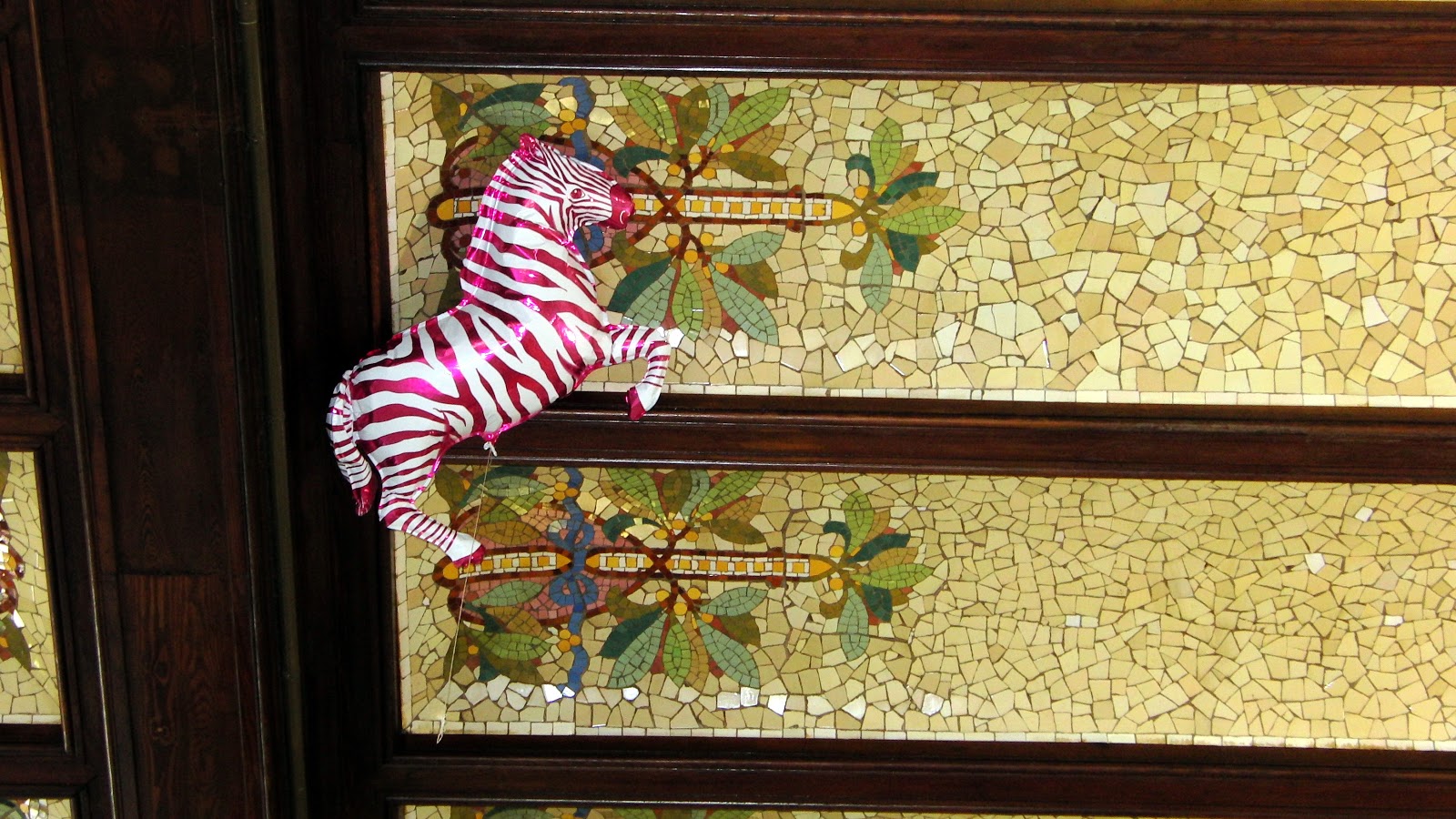
The columns and ceilings are also covered with mosaics:
 The pink zebra is a left over from the Fallas, the big festival that ended on the 19th (just before I came):
 And the wall to the waiting room has more mosaics and a big clock

Tomorrow I´ll show you the tile paintings in the waiting room...

The columns and ceilings are also covered with mosaics:


Tomorrow I´ll show you the tile paintings in the waiting room...
Dienstag, 26. März 2013
Estación del Norte de Valencia (I)
Since the Estación del Norte was the first building in Valencia that I saw, I find it finally time that I wrote something about it. And as it often happens with me and ceramics, it is getting rather detailed and will come in different parts.
The Railway Station Valencia-North was built between 1907 and 1917 in the most modern style of the time: the modernism of the type of viennese secession, influenced by Otto Wagner and constructed by the architect Demetrio Ribes Marco.


The five-pointed red star is the logo of the railway company Compañia de los Caminos de Hierros del Norte de España. Other decorative elements that are used are the red and yellow stripes of the coat of arms of Valencia and oranges as the symbol of valencian agriculture. The eagle on top of the roof stands for velocity.

Near the entrance are two mosaics by José Mongrell, said to depict the guardians of the day and night.

The Railway Station Valencia-North was built between 1907 and 1917 in the most modern style of the time: the modernism of the type of viennese secession, influenced by Otto Wagner and constructed by the architect Demetrio Ribes Marco.


The five-pointed red star is the logo of the railway company Compañia de los Caminos de Hierros del Norte de España. Other decorative elements that are used are the red and yellow stripes of the coat of arms of Valencia and oranges as the symbol of valencian agriculture. The eagle on top of the roof stands for velocity.

Near the entrance are two mosaics by José Mongrell, said to depict the guardians of the day and night.

Sonntag, 12. August 2012
Jardin des Plantes
Von gestern habe ich noch gar nichts erzaehlt: es war mal wieder ein Keramiktag :-) Da wollte ich in meinem anderen blog noch was dazu schreiben. Aber hier zeige ich euch mal ein paar der schoenen Geschaefte, in denen es noch alte Fliesen an Waenden oder Fussboden gibt:


Confiserie A la Mere de Famille - (schaut euch auch die schoene homepage an!)
9. arr.; 35 rue de Faubourg-Montmartre

hier habe ich mir ein Pfefferminzeis gegoennt....
---------------------------------------------------------

Boulangerie Bazin
12. arr.; 85 bis, rue de Charenton


hier musste es ein Erdbeertoertchen sein....
------------------------------------------------------------------
Heute war ich im Jardin des Plantes. Die Menagerie ist der zweitaelteste Zoo der Welt ( ich habe aber nicht rausgekriegt, welches der aelteste ist...).
Die Flamingos sind noch genauso wie aus Rilkes Zeiten (das Gedicht habe ich euch schon mal hier vorgestellt),

Panther gibt es zum Glueck keine mehr; der Zoo hat sich wegen seiner geringen Groesse mittlerweile auf seltene Voegel und kleinen Saeugetiere spezialisiert.
Und in der Rotunde gab es eine kleine Ausstellung ueber Zarafa - und dank Nigel's und Eva's umfangreicher Bibliothek, (die ich aufgeraeumt habe) wusste ich auch sofort, um was es sich handelt: die erste lebendige Giraffe, die 1827 nach Paris kam!

Und zwar zu Fuss - also auf eigenen Hufen! - in Tagesetappen die letzten 880 km von Marseille

And here is a link to the really great book and finally one to the blog of the author, Michael Allin.
Samstag, 11. August 2012
Galeries LaFayette und Paradis


Dort habe ich auch gepicknickt und meine mitgebrachte Banane gegessen :-), bevor ich ins "Paradis" gegangen bin!

Dort steht noch das Geschaeftshaus einer Keramikfirma: Hippolyte Boulenger aus Choisy-le-Roi

(Morgen muss ich nochmal hin, denn dann hat dieses Gruselkabinett auf, das jetzt in dies Gebaeude eingezogen ist und man konnte im Eingangspatio hinter dem Gitter noch weitere Fliesenbilder entdecken.) Die Firma ist auch bekannt dafuer, das sie die Fliesenverkleidungen der Metrostationen ausgefuehrt hat.
Nachmittags habe ich mir eine Eisbecher gegoennt...

... natuerlich vor allem um in Musse das Lokal GALLOPIN (hier die homepage) ...

... und die Fliesen bewundern zu koennen!


Und jetzt gehe ich in mein Himmelbett mit Katzen!

Freitag, 10. August 2012
more ceramics and celebreties
In the morning I had to go again to the porcelain factory of Sevres to make the guided tour of the workshops - and it was really worth it! I could talk for hours (and I really understood most of it!), but i'll just show you some pictures: and also I'll have to switch back to German, because I lack the specific vocabulary.
 Die Stuecke werden erst auf einer Toepferscheibe gedreht
 und dann mit einem Kalibriergerat auf genau die gleiche Groesse gebracht. Nachdem sie etwas vorgetrocknet wurden, folgt der Schruehbrand und dann ein hoeherer Brand mit (weisser oder farbloser?) Glasur.
Auf die Glasur werden die Farben aufgetragen, Umrisse mit Transferdruck vorgefertigt und fast jede Farbe braucht wieder ihren eigenen Brand.
Fuer besondere Zwecke werden auch noch Holz befeuerte Oefen verwandt. So ein Ofen muss 2 Tage brennen - dabei natuerlich rund um die Uhr bewacht werden und Holz nachgelegt, dann wird die Luftzufuhr geschlossen unnd der Ofen braucht 3 Wochen! zum auskuehlen.


Danach bin ich mit der Metro quer durch die Stadt zu dem beruehmten Friedhof Pere Lachaise gefahren. Ueber die Metro und ihre Dekoration koennte ich auch eine ganze Menge schreiben, vielleicht mache ich das ja spaeter noch mal...

Hier liegen Beruehmtheiten wie Moliere, La Fontaine, Balzac, Daudet, Chopin, Edith Piaf, Yves Montand.... und vor allem Oscar Wilde und natuerlich Jim Morrison.
Jimmy findet den Rummel ja vielleicht noch ganz anregend, sein "Nachbar" auf dessen Mausoleum Light my fire und Riders on the Storm gekritzelt ist, bestimmt weniger!


Auf die Glasur werden die Farben aufgetragen, Umrisse mit Transferdruck vorgefertigt und fast jede Farbe braucht wieder ihren eigenen Brand.
Fuer besondere Zwecke werden auch noch Holz befeuerte Oefen verwandt. So ein Ofen muss 2 Tage brennen - dabei natuerlich rund um die Uhr bewacht werden und Holz nachgelegt, dann wird die Luftzufuhr geschlossen unnd der Ofen braucht 3 Wochen! zum auskuehlen.


Danach bin ich mit der Metro quer durch die Stadt zu dem beruehmten Friedhof Pere Lachaise gefahren. Ueber die Metro und ihre Dekoration koennte ich auch eine ganze Menge schreiben, vielleicht mache ich das ja spaeter noch mal...

Hier liegen Beruehmtheiten wie Moliere, La Fontaine, Balzac, Daudet, Chopin, Edith Piaf, Yves Montand.... und vor allem Oscar Wilde und natuerlich Jim Morrison.
Jimmy findet den Rummel ja vielleicht noch ganz anregend, sein "Nachbar" auf dessen Mausoleum Light my fire und Riders on the Storm gekritzelt ist, bestimmt weniger!

Und was der arme Oscar Wilde wohl von heissen Lippenstiftkuessen haelt....???

Montag, 6. August 2012
Musee Nationale de la Ceramique
The Ceramic Museum is the only museum which is open on Mondays, and anyway it was high on my list of priorities. Sevres is just a little outside of Paris and only two metro stops from my place. From there you cross the river Seine - it is a real working river with barges... and house-boats! The impressive building in the back is the museum:

And closer:

The porcelain factory of Sevres was founded in 1740 and around 1800 the owner Alexandre Brogniart decided to also collect all kinds of pottery, earthenware, stoneware, porcelain, faiance, majolica etc. from all around the world and through all times and establish a museum.
And it is really a very impressive collection: old Egyptian, Greek, Roman, Bycantine, Islamic from Iran, Irak, Turkey, renaissance Italian, Spanish (though mainly Manises and Valencia and nothing about Triana!), Delft, from Germany there was the blue-grey salt glazed Western Forest stoneware and the bearded man's jugs from the Rhine, also Korea, Japan, with an extra section about the tea ceremony, China and of course all the important French makers including Sevres themselves....
I was there more than three hours and then I had also applied for a tour though the workshops - but when I got there it was over! I had not understood the time correctly, instead of treize trente (13.30) I understood trois trente (3.30)! Shit! There will be another tour on Thursday... if I have time I'll go again!

And closer:

The porcelain factory of Sevres was founded in 1740 and around 1800 the owner Alexandre Brogniart decided to also collect all kinds of pottery, earthenware, stoneware, porcelain, faiance, majolica etc. from all around the world and through all times and establish a museum.
And it is really a very impressive collection: old Egyptian, Greek, Roman, Bycantine, Islamic from Iran, Irak, Turkey, renaissance Italian, Spanish (though mainly Manises and Valencia and nothing about Triana!), Delft, from Germany there was the blue-grey salt glazed Western Forest stoneware and the bearded man's jugs from the Rhine, also Korea, Japan, with an extra section about the tea ceremony, China and of course all the important French makers including Sevres themselves....
 |
| Islamic tile |
 |
| Chinese cat |
 |
| Japanese dish |
 |
| "Hall of Fame" with vases from Sevres |
 |
| French plates |
 |
| view from a museum window to the factory |
Abonnieren
Posts (Atom)


